
For international buyers reviewing options across the European continent, the primary question has shifted from simple geographic preference to long-term structural security. Global events—ranging from persistent friction in Ukraine and the Middle East to deep domestic political adjustments within the UK, the Netherlands, Germany, and the United States—are prompting a reallocation of private capital. Increasingly, individual buyers are turning their attention toward the Spanish real estate sector as a stable environment to preserve wealth and establish a reliable alternative base.
The underlying rationale extends beyond typical lifestyle factors. In practical terms, buyers are reacting to legislative changes, fiscal pressure, and social shifts in their home nations. To understand this movement, it helps to examine both the specific push factors abroad and the structural characteristics currently supporting the property market in Spain.
The choice to acquire Spanish real estate is often accelerated by systemic issues within a buyer’s home country. According to recent European and North American market analysis, domestic policy adjustments are acting as major drivers for relocation and investment.
For many buyers from the UK, recent fiscal policy changes have altered the financial landscape. Following the abolition of the non-domicile tax status and changes to inheritance tax structures, high-net-worth individuals are reassessing their tax residencies. A recent analysis by The Financial Times highlighted an accelerating outflow of affluent residents seeking jurisdictions with more predictable tax treatments and established frameworks for international property owners.
Furthermore, British buyers are reacting directly to domestic property tax updates and the rising cost of UK council taxes. In contrast, the regional government of the Valencian Community has actively adapted its fiscal climate to attract international capital. Through recent legislative adjustments (Law 5/2025), the region has doubled the wealth tax exemption threshold to 1,000,000 euros per person and lowered the property transfer tax (ITP) for resale homes to 9%. This contrasting tax trajectory makes areas within the New Life Property Spain portfolio a highly structured vehicle for wealth preservation.
Beyond physical housing shortages, buyers are reacting to shifting fiscal landscapes and structural asset mandates across Northern Europe.
In the Netherlands, ongoing restructuring and tightening of the "Box 3" asset tax have made traditional domestic savings accounts and local rental investments far less lucrative. Wealthy Dutch citizens are actively repositioning capital out of Dutch jurisdiction into tangible foreign real estate. Because Spain’s double-taxation treaty allows for favorable wealth balancing, high-end Spanish brick-and-mortar has become a preferred safe haven for capital protection.
Simultaneously, German buyers are navigating severe infrastructure and energy anxieties. The energy cost volatility frequently cited by German media, including Handelsblatt, isn't just about monthly utility bills; it is driven by long-term domestic building mandates. Germany's strict energy efficiency requirements—such as mandated heat-pump installations and intensive, costly insulation retrofits—mean that owning a home domestically carries massive, forced future capital expenditures. Buyers realize that in the Costa Blanca, the base infrastructure costs are lower, and the natural climate minimizes structural energy reliance from the outset.
The influx of North American buyers into the Spanish market has reached unprecedented levels. Data from international mobility surveys published by The Wall Street Journal point to a combination of political polarization at home, escalating domestic real estate prices, and the sustained purchasing power of the US dollar against the Euro.
For an American buyer, premium areas along the Costa Blanca offer infrastructure and healthcare standards that rival domestic options at a significantly lower capital outlay. More importantly, US buyers are prioritizing personal safety and institutional stability. Spain stands out globally as a non-belligerent, secure European nation with low geopolitical exposure and a fully integrated Eurozone banking system. In a fragmented global landscape, the predictability of the Spanish legal framework provides a level of reassurance that is increasingly difficult to find in domestic US metropolitan areas.
When international capital arrives in Spain, it enters a market defined by strict institutional lending practices and a notable supply deficit, both of which protect asset value.
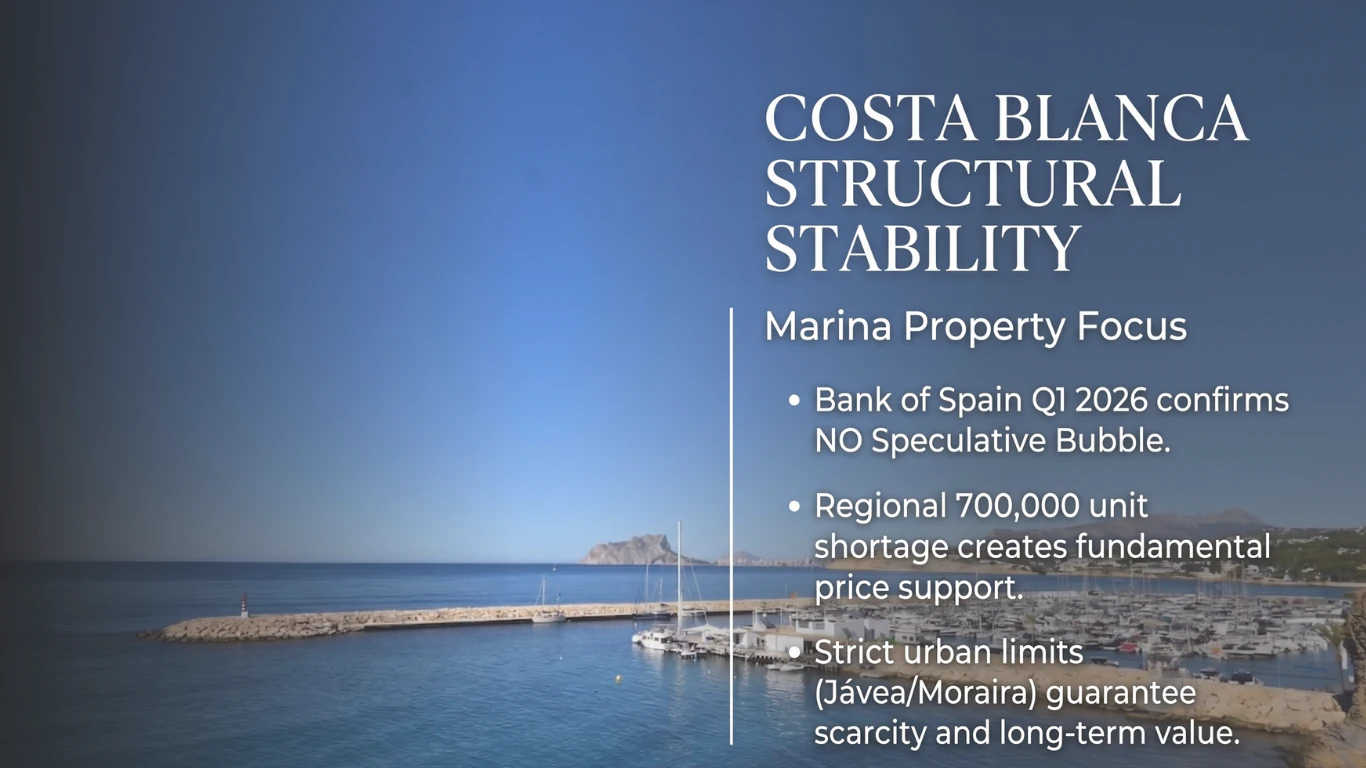
A central concern for anyone investing overseas is the long-term health of the local real estate sector. The Spring 2026 Financial Stability Report issued by the Bank of Spain provides clear clarity on this topic, explicitly ruling out the existence of a speculative property bubble.
National house prices in Spain remain approximately 15% below their 2008 peak when adjusted for inflation. The central bank emphasizes that today's market dynamics are fundamentally different from the pre-crisis era:
Strict Lending Standards: Unlike the loose credit environment of twenty years ago, current mortgage practices require significant equity. The average loan-to-value (LTV) ratio sits below 70% for non-residents, ensuring that buyers are well-capitalized.
Fixed-Rate Dominance: The majority of existing mortgages are structured on fixed rates, shielding the broader market from interest rate fluctuations and keeping default rates near historic lows.
The Supply Deficit: The Bank of Spain estimates a national housing deficit of roughly 600,000 to 700,000 units. Spain currently produces around 140,000 to 150,000 new build permits annually, which fails to meet the net household formation rate of 180,000 per year. This structural shortage creates a natural floor for property values, particularly in premium coastal locations.
Regional Spotlight: Costa Blanca North and the Marina Alta
While national data confirms market resilience, real estate decisions depend entirely on specific micro-markets. The Marina Alta region—encompassing coastal nodes such as Jávea, Moraira, and Dénia—continues to attract the highest concentration of international transactions.
It is worth noting that within the Valencian Community, property prices grew by 18.0% over the past year, with the Alicante province leading foreign buyer participation at 51.8% of all recorded transactions.
Global political and economic shifts do not alter the legal mechanics of property acquisition in Spain. The process remains highly regulated and secure. Non-resident buyers must secure a NIE (Tax Identification Number) and open a Spanish bank account. Working with an established legal representative ensures that all title deeds, urban planning compliance, and tax structures are fully verified.
The data indicates that waiting for a price correction may result in higher entry costs. With independent research entities like CaixaBank Research and BBVA forecasting continued national price growth of 5% to 7% through the end of 2026, driven entirely by the housing supply deficit, securing a property under current market conditions protects against future escalation. Furthermore, the Valencian Community's decision to adjust the property transfer tax (ITP) down to 9% from June 2026 offers an immediate capital saving on resale purchases.
Premium coastal real estate in the Marina Alta functions independently from standard domestic markets. Because local land availability is strictly regulated, the scarcity of available homes guarantees strong value retention. International demand from high-earning professionals and retirees ensures a consistent liquidity pool when the time comes to divest.
Find your perfect Property